


As a seasoned supplier of hydraulic lifts, I've witnessed firsthand the pivotal role these machines play across a wide range of industries. From construction sites to warehouses, hydraulic lifts are essential for hoisting heavy loads and providing access to elevated areas. One of the most critical aspects of a hydraulic lift's design is its shock - absorbing mechanisms. These mechanisms are crucial for ensuring the safety, durability, and smooth operation of the lift. In this blog, I'll delve into the shock - absorbing mechanisms of hydraulic lifts and explain why they are so important.

The Basics of Hydraulic Lifts
Before we discuss the shock - absorbing mechanisms, let's briefly review how hydraulic lifts work. A hydraulic lift operates on the principle of Pascal's Law, which states that pressure applied to an enclosed fluid is transmitted equally in all directions. In a hydraulic lift, a hydraulic fluid, usually oil, is pumped into a cylinder. The pressure of the fluid forces a piston to move upwards, lifting the platform or load attached to it. When the lift needs to descend, the hydraulic fluid is released back into the reservoir, allowing the piston to lower.
Importance of Shock Absorption in Hydraulic Lifts
Shock absorption is essential in hydraulic lifts for several reasons. First and foremost, it enhances safety. When a lift starts or stops, or when a load is placed or removed suddenly, there are significant forces at play. Without proper shock absorption, these forces can cause sudden jolts and vibrations, which may lead to the instability of the lift and pose a danger to the operators and the load.
Secondly, shock absorption helps to protect the components of the lift. The constant impact and vibration can cause wear and tear on the mechanical parts, hydraulic cylinders, and other components of the lift. Over time, this can lead to component failure, costly repairs, and downtime. By reducing the impact forces, the shock - absorbing mechanisms extend the lifespan of the lift and reduce maintenance costs.
Finally, shock absorption contributes to a smoother operation. A lift that operates smoothly is more comfortable for the operators and can improve productivity. It also allows for more precise positioning of the load, which is particularly important in applications where accuracy is crucial.
Types of Shock - Absorbing Mechanisms in Hydraulic Lifts
Hydraulic Cushioning
Hydraulic cushioning is one of the most common shock - absorbing mechanisms used in hydraulic lifts. It works by restricting the flow of hydraulic fluid as the piston approaches the end of its stroke, either at the top or bottom of the lift. This creates a back - pressure that slows down the movement of the piston gradually, reducing the impact when it reaches the end of the stroke.
In a hydraulic cushioning system, there are usually small valves or orifices at the end of the hydraulic cylinder. As the piston nears the end of its stroke, it covers these orifices, gradually increasing the resistance to the flow of hydraulic fluid. The rate of flow is reduced, and the piston comes to a smooth stop.
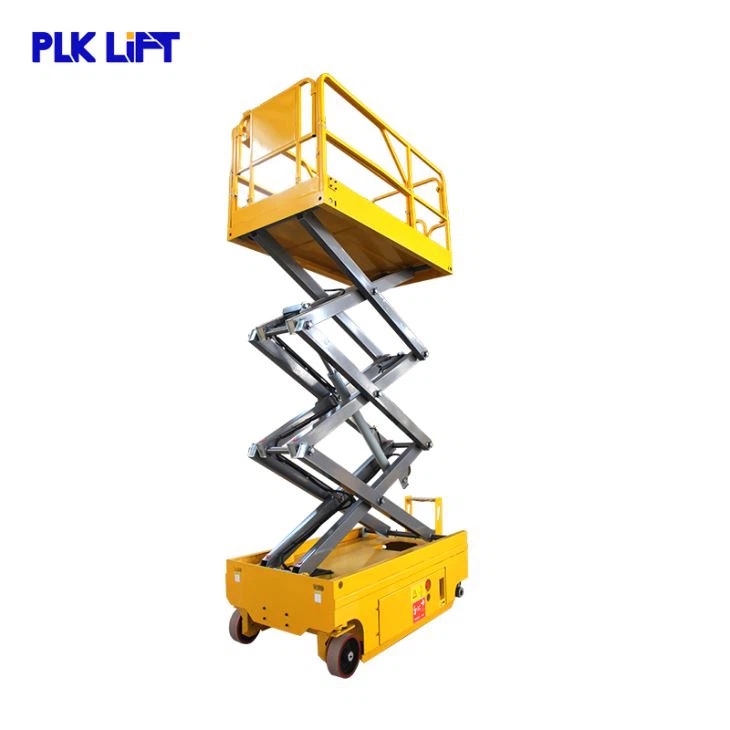
For example, in our Hydraulic Scissor Lift, hydraulic cushioning plays a vital role in ensuring a safe and gentle stop at the end of the lifting and lowering cycles. This feature not only protects the lift and the load but also enhances the operator's experience.
Spring - Based Shock Absorbers
Spring - based shock absorbers are another common type of shock - absorbing mechanism in hydraulic lifts. Springs are used to absorb and dissipate the energy generated by sudden impacts or vibrations. When a shock occurs, the spring compresses, storing the energy. Then, as the spring expands, it releases the energy in a more controlled manner.
In hydraulic lifts, springs can be used in various locations. For instance, they can be installed at the base of the lift to absorb the impact when the lift touches the ground after descending. They can also be incorporated into the scissor arms in scissor lifts to dampen vibrations during operation. Our 12m Non - marking Full Hydraulic Scissor Lift utilizes high - quality springs in its design to enhance shock absorption and overall stability.
Rubber Mounts
Rubber mounts are simple yet effective shock - absorbing components. They are made of rubber and are used to isolate different parts of the lift from each other, reducing the transmission of vibrations and shocks. Rubber mounts can be placed between the lift platform and the scissor arms, or between the lift structure and the base.
The rubber material has excellent elastic properties, which allow it to deform under stress and then return to its original shape. When a shock occurs, the rubber mount absorbs the energy by deforming, preventing it from being transferred to other parts of the lift. This helps to protect the components and reduces noise and vibrations during operation.
Advanced Shock - Absorbing Technologies
In addition to the traditional shock - absorbing mechanisms, there are also some advanced technologies being used in modern hydraulic lifts.
Electronic Control Systems
Some hydraulic lifts are now equipped with electronic control systems that can adjust the shock - absorbing effect in real - time. These systems use sensors to detect the speed, load, and acceleration of the lift. Based on the data collected, the electronic control unit can adjust the flow rate of the hydraulic fluid or the stiffness of the shock absorbers to provide optimal shock absorption.
For example, if the lift is carrying a heavy load or is moving at a high speed, the system can increase the damping force to ensure a smooth and safe operation. Our 8M To 16m Self Propelled Scissor Lift features an advanced electronic control system for precise shock absorption and enhanced performance.
Adaptive Suspension Systems
Adaptive suspension systems are another innovative approach to shock absorption in hydraulic lifts. These systems can automatically adjust the suspension characteristics based on the operating conditions. They typically use actively controlled dampers that can change their stiffness in response to different loads and movements.
This allows the lift to maintain a stable and smooth ride, regardless of the weight of the load or the unevenness of the surface. Adaptive suspension systems are particularly beneficial in applications where the lift needs to operate on rough or uneven terrain.
Conclusion
The shock - absorbing mechanisms of hydraulic lifts are a critical aspect of their design. They enhance safety, protect the components, and contribute to a smooth and efficient operation. Whether it's traditional hydraulic cushioning, spring - based shock absorbers, or advanced electronic and adaptive technologies, each type of shock - absorbing mechanism plays an important role in ensuring the performance and longevity of the lift.
As a hydraulic lift supplier, we are committed to providing high - quality products with the latest shock - absorbing technologies. Our lifts are designed to meet the highest safety and performance standards, making them suitable for a wide range of applications.
If you are in the market for a hydraulic lift and want to learn more about our products or discuss your specific requirements, we invite you to contact us. We look forward to the opportunity to work with you and provide you with the best hydraulic lift solutions.
References
- "Hydraulic Systems Technology" by Robert Scheid.
- "Mechanical Engineering Design" by Joseph Edward Shigley.


